
A content marketing agency is a specialized firm that plans, produces, and distributes content to drive measurable business growth for clients. The industry has matured well past blog posts and social captions. Today, the best content marketing firms operate as growth infrastructure partners, connecting every piece of content directly to sales pipeline and revenue. This guide gives aspiring entrepreneurs a clear, step-by-step path to launching and scaling a digital content agency, from foundational setup through client acquisition and sustainable growth. Follow it and you will build a firm that clients pay to keep.
What does a content marketing agency actually need to launch?
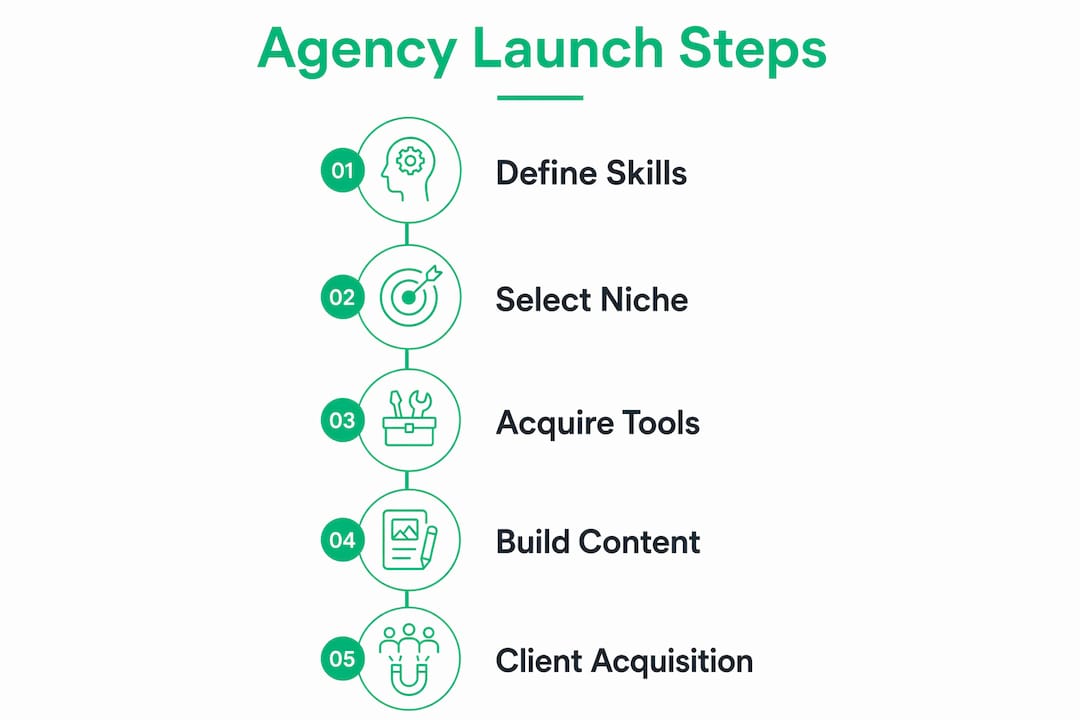
Launching a content marketing agency requires three things before you sign your first client: a defined skill set, a lean team structure, and the right tools. Skipping any one of these creates gaps that clients notice fast.
Core skills you need on day one
You need working knowledge of content strategy, basic SEO, and sales. You do not need to be an expert in all three, but you must understand how they connect. A strategist who cannot explain why a piece of content belongs in the funnel will lose client trust within 90 days.
Your founding team should cover these roles, even if one person wears multiple hats:
- Content strategist: Owns keyword clustering, funnel mapping, and editorial planning
- Writer or editor: Produces and quality-checks all deliverables
- Designer: Handles visual assets, infographics, and formatting
- Account manager: Manages client communication and reporting
Tools that support early operations
You do not need an enterprise tech stack on day one. Start with a content management system, a keyword research tool such as Ahrefs or Semrush, a project management platform like Asana or Notion, and a basic analytics setup through Google Analytics 4 and Google Search Console. These four categories cover 90% of what a new agency needs to deliver professional work.

Pro Tip: Niche down before you scale up. Agencies that specialize in one vertical, such as SaaS, healthcare, or e-commerce, close clients faster and charge higher retainers than generalist shops. Clients pay a premium for proven domain expertise.
| Role | Primary Responsibility |
|---|---|
| Content strategist | Keyword research, funnel mapping, editorial calendar |
| Writer or editor | Content production and quality review |
| Designer | Visual assets and content formatting |
| Account manager | Client reporting and relationship management |
How do you build a content framework that drives client revenue?
Content strategy is the architectural phase before execution. Without proper planning, publishing frequency is a vanity metric. A framework that drives revenue connects every content asset to a buyer journey stage and a measurable business outcome.
Pillar and cluster architecture
The pillar-and-cluster model is the most reliable structure for building topical authority. A pillar page covers a broad topic in depth. Cluster pages target specific subtopics and link back to the pillar. This structure signals to search engines that your client owns a topic, not just a keyword.
Build each cluster around intent. Awareness-stage content answers broad questions. Consideration-stage content compares approaches and solutions. Decision-stage content addresses objections and drives conversion. Mapping content to these three stages is how you connect editorial output to pipeline.
Production cadence and AI search optimization
Effective B2B content programs require a minimum of 4–8 long-form articles per month to build topical authority and capture buyer intent across the funnel. That cadence gives search engines enough signal to rank your client's site while giving buyers enough content to move through the funnel.
In 2026, AI Search Optimization (AEO) is no longer optional. AI-driven search environments like Perplexity and Google's AI Overviews favor content with semantic clarity, structured headings, and schema markup. Build these requirements into your production templates from the start.
Here is a repeatable framework for building a client content strategy:
- Conduct a full content audit to identify gaps, cannibalization, and quick-win opportunities
- Define buyer personas and map existing content to funnel stages
- Build a keyword cluster map organized by topic, intent, and search volume
- Create a pillar page outline for each primary topic
- Assign cluster articles to each pillar and set a monthly production target
- Build an editorial calendar with deadlines, owners, and distribution channels
- Define KPIs for each funnel stage: impressions and clicks at awareness, leads at consideration, pipeline at decision
Volume-first content approaches often fail to build E-E-A-T. Content must be mapped to buyer journey stages and revenue proximity for sustainable success. That is the difference between an agency that produces content and one that produces results.
How do you acquire clients and manage their expectations?
Client acquisition for a new content creation company starts with auditing. Offer a complimentary 30–60-minute strategy audit before any engagement. This gives you a chance to demonstrate expertise, identify funnel gaps the client did not know existed, and position your agency as the solution.
Clients often underestimate the value of detailed content audits that reveal gaps and cannibalization issues. A thorough audit that surfaces three to five specific problems closes more deals than any sales deck.
Pricing and scope
Typical B2B content marketing retainers range from $3,000 to $12,000 per month based on scope and complexity. Set your pricing based on deliverables, not hours. Hourly pricing invites scope creep and undervalues strategic work.
Protect your margins with a clear scope of work document. Define exactly what is included: number of articles, word counts, revisions, distribution, and reporting. Anything outside that scope is a change order.
Pro Tip: Report on pipeline influenced and lead attribution, not just traffic and rankings. Clients who see content tied to revenue renew contracts. Clients who only see pageview reports cancel them.
Key pitfalls to avoid in client management:
- Promising organic results in less than 60 days. Measurable traffic improvements typically appear within 60–90 days, and full lead generation compounding takes 4–9 months.
- Accepting vague briefs. Every piece of content needs a defined goal, target persona, and funnel stage before production starts.
- Skipping monthly reporting calls. Regular calls catch misaligned expectations before they become cancellations.
- Letting clients dictate keyword strategy without data. Your job is to educate, not just execute.
Successful agencies act as growth infrastructure partners, attributing content directly to sales pipeline rather than vanity traffic metrics. That positioning is what separates a vendor from a trusted partner.
How do you scale a content agency without losing quality?
Scaling a content marketing agency sustainably means building repeatable systems before adding headcount. The agencies that grow fastest are the ones that document everything: briefs, style guides, editorial workflows, and client feedback loops.
AI accelerates content production but human judgment preserves quality and brand voice. Use AI tools to handle research, outline generation, and first drafts. Reserve human editors for structural review, fact-checking, and voice alignment. This combination keeps output high without sacrificing the editorial standards clients pay for.
Growth levers worth prioritizing
As your agency stabilizes, expand your service offerings in a sequence that matches your team's capacity:
- Video scripts and production briefs: High demand, high margin, and a natural extension of written content
- Interactive content: Calculators, assessments, and quizzes that capture leads directly
- Multi-format repurposing: Turning one long-form article into a LinkedIn carousel, email sequence, and short-form video
- Sales enablement content: Case studies, one-pagers, and battle cards that integrate with CRM workflows and support the sales team directly
Hire specialists before you need them. A dedicated SEO strategist, a video editor, and a data analyst each unlock a new tier of client work. Generalists get you started. Specialists get you to $50,000 per month in recurring revenue.
Scaling agencies need repeatable workflows that combine AI content generation with rigorous editorial review and adaptive client feedback loops. Build those workflows in writing, train every new hire on them, and audit them quarterly.
Key Takeaways
A content marketing agency succeeds when it connects every content asset to a measurable business outcome, from the first audit through monthly reporting.
| Point | Details |
|---|---|
| Niche before scaling | Specializing in one vertical closes clients faster and commands higher retainers. |
| Strategy before production | Build keyword clusters and funnel maps before writing a single word. |
| Price on deliverables | Retainers from $3,000 to $12,000 per month protect margins better than hourly rates. |
| Report on pipeline | Lead attribution and pipeline influenced retain clients longer than traffic reports. |
| AI plus human review | Use AI for speed and human editors for quality to maintain brand voice at scale. |
What I have learned from building in this space
The biggest mistake new agency owners make is treating content volume as proof of value. I have watched founders publish 20 articles a month for clients and still lose the contract because none of those articles moved a lead through the funnel. Strategy before volume is not a philosophy. It is the only approach that survives a client's quarterly budget review.
The second lesson is harder to accept: clients do not understand content ROI timelines until you teach them. The 4–9 month compounding window for organic lead generation is not a bug in the model. It is how search engines work. Your job is to set that expectation in writing before the engagement starts, then show progress at every monthly call with leading indicators like keyword rankings, indexed pages, and assisted conversions.
On AI tools: I use them every day, and I would not run a content operation without them. But I have also seen agencies hand AI output directly to clients without a human edit, and the results are always the same. The content sounds generic, the brand voice disappears, and the client leaves. Editorial-led agencies build programs that integrate AI with brand-specific training to preserve quality. That is the standard worth holding.
The agencies that last are the ones that educate their clients, report on revenue, and never confuse publishing with strategy.
— cooper
Ready to build your agency with a proven framework?
Building a content agency from scratch is faster when you start with a tested blueprint instead of figuring everything out on your own. Ofmagency's OFM Course gives you a complete curriculum, client acquisition scripts, and high-converting funnel templates for $50.
The course is built for people with no prior agency experience and includes access to a community of active members. A 14-day money-back guarantee means you can go through the material with zero financial risk. If you are ready to move from planning to execution, the OFM Course is the most direct path to your first paying client.
FAQ
What does a content marketing agency do?
A content marketing agency plans, produces, and distributes content to drive measurable business results for clients. Services typically include content strategy, SEO, editorial production, and performance reporting tied to pipeline and lead generation.
How long does it take to see results from content marketing?
Measurable organic traffic improvements appear within 60–90 days of implementing a content strategy. Full lead generation compounding typically takes 4–9 months of consistent execution.
How much do content marketing agencies charge?
B2B content marketing retainers typically range from $3,000 to $12,000 per month, depending on scope and the number of deliverables included. Pricing based on deliverables rather than hours protects both agency margins and client expectations.
What is the best niche for a new content agency?
The best niche is one where you already have domain knowledge or a professional network. SaaS, healthcare, financial services, and e-commerce are high-demand verticals with clients who understand the value of content strategy services.
How do I scale a content agency without losing quality?
Build repeatable workflows that combine AI content generation with human editorial review. Document every process, train new hires on your standards, and audit your workflows quarterly to catch quality drift before clients do.