
Objection handling in sales is the process of actively listening to, clarifying, and addressing a prospect's concerns to move a deal forward. 67% of deals are lost before the proposal stage because objections go unaddressed. That number alone should change how you treat every pushback you hear on a call. The good news is that 84% of objections are not genuine rejections. They are smoke screens covering deeper concerns, and that means they are solvable if you know the right method.
What is objection handling in sales and why it matters
A sales objection is a stated reason a prospect gives for not moving forward. A brush-off is different. "Send me an email" is a brush-off. "Your price is too high compared to what we budgeted" is an objection. The distinction matters because objections deserve a real response, while brush-offs usually signal the wrong timing or fit.
The most important mindset shift in overcoming sales objections is this: objections signal engagement. Prospects who raise objections are 6x more likely to buy than those who go silent. Silence means indifference. An objection means the prospect is still thinking about your offer.
The four most common objection categories in B2B sales break down by frequency:
- Price objections occur in 73% of B2B calls. They rarely mean the prospect has no money. They usually mean they do not yet see enough value.
- Timing objections appear in 52% of calls. "Now is not a good time" often means "I have not prioritized this yet."
- Authority objections show up in 45% of calls. "I need to check with my boss" signals a buying committee you have not fully mapped.
- Fit and need objections are less frequent but harder to resolve because they often reflect a qualification gap from earlier in the process.
Recognizing which category you are dealing with tells you which tool to reach for. Treating every objection as a price problem is one of the fastest ways to lose deals you should have won.
How to handle sales objections using the LAER framework
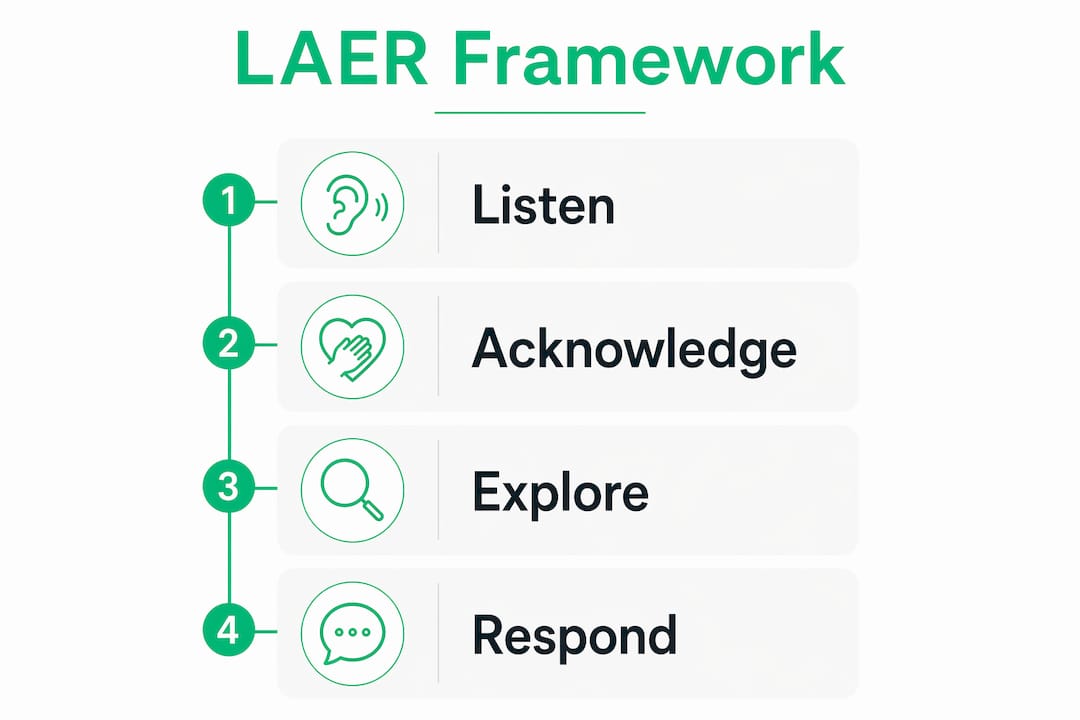
The LAER framework is the most structured and repeatable method for effective objection handling. LAER stands for Listen, Acknowledge, Explore, and Respond. Each step has a specific job, and skipping any one of them breaks the sequence.
-
Listen. Stop talking the moment the objection starts. Do not plan your rebuttal while the prospect is still speaking. Full listening is not just polite. It gives you the actual words the prospect used, which you will reflect back in the next step.
-
Acknowledge. Repeat or paraphrase the objection before you respond. "So what I'm hearing is that the budget cycle closes in Q1 and this purchase would need to wait. Is that right?" Acknowledgment does two things. It confirms you understood, and it slows the emotional temperature of the conversation.
-
Explore. Ask one open diagnostic question before you give any answer. This is the step most sales professionals skip, and skipping the Explore step is where deals are won or lost. "What would need to be true for this to make sense in your budget?" or "What's driving the timing concern specifically?" These questions surface the real issue beneath the stated objection.
-
Respond. Only after you have listened, acknowledged, and explored should you give your response. Your answer should address the root concern you uncovered, not the surface words you first heard.
The entire LAER process takes 60–90 seconds per objection. That pace keeps call momentum alive while giving the prospect enough space to feel heard.
Pro Tip: After your response, always confirm resolution. Ask "Does that address your concern?" before moving forward. Reps who skip this step often advance a call while the prospect is still stuck on the original objection.
One critical rule: objection handling is not a pressure tactic. Its purpose is to help the prospect surface their real priorities, not to bulldoze hesitation. Reps who treat it as a debate to win consistently underperform those who treat it as a diagnostic conversation.

Common sales objections and how to respond to each
Every sales professional needs a working set of sales objection responses for the categories they face most often. Generic rebuttals fail because they address the surface word, not the root concern. The responses below are built around diagnosis first.
Price objections
The worst response to "your price is too high" is an immediate discount. Discounting on the first price objection trains buyers to push back every time. Instead, ask: "Compared to what?" That single question reveals whether the concern is budget, competitor pricing, or perceived value. Once you know the root, you can frame ROI or quantify the cost of inaction. "If this problem costs you EX per month and we solve it in 60 days, what does waiting another quarter actually cost you?"
Timing objections
"Now is not the right time" is almost never about the calendar. It is about priority. Your job is to quantify the delay. Ask: "What changes between now and [the future date they named]?" If they cannot name a concrete change, the timing objection is really a priority objection. Help them see what staying in the current state costs them each month.
Authority objections
When a prospect says "I need to run this by my manager," do not wait for a follow-up email that may never come. Ask: "Who else is typically involved in decisions like this? Would it make sense to include them in our next conversation?" Getting the full buying committee on a call is far more effective than sending a deck and hoping it gets forwarded.
Competitor and need objections
Reframing a competitor objection without naming or criticizing the competitor is a discipline worth building. Ask: "What is it about your current solution that made you take this call today?" That question surfaces the gap the prospect already feels. Need objections ("we're fine with what we have") respond best to a question like: "What would have to happen for this to become a priority?" Both responses use diagnostic questions to uncover real concerns before any rebuttal.
The pattern across all categories is the same: address the root concern, not the surface objection. The most common pitfall is answering the words instead of the worry behind them.
How to prepare for objections before every call
Preparation is what separates reps who handle objections well from those who freeze. Top performers build objection libraries from real call recordings, not generic scripts. After every call, note the exact objection phrasing, what you said, and whether it worked. Over time, patterns emerge that let you anticipate objections before they surface.
Role-playing objection handling is the most effective training method for building the muscle memory you need in live calls. The goal of role-play is not to memorize a script. It is to practice pacing, acknowledging, and probing until the LAER sequence feels natural rather than mechanical.
Qualifying prospects early prevents the worst kind of objection: one you cannot resolve. If a prospect has no budget authority and no timeline, no amount of objection handling will close that deal. Spend the first few minutes of every call confirming budget range, decision-making authority, and urgency. That information tells you which objections are real and which ones signal a mismatched fit.
Pro Tip: Record your calls and review them specifically for the moment an objection lands. Notice your pacing, your first word after the objection, and whether you explored before responding. That 90-second window is where your improvement lives.
Three habits that build objection handling confidence over time:
- Review one recorded call per week and identify one objection you could have handled better.
- Practice the Explore step in low-stakes conversations, not just sales calls. The habit of asking one diagnostic question before responding transfers directly.
- Build feedback loops with coaching from a manager or peer. Experienced reps improve faster when they get targeted feedback on specific objection moments rather than general performance reviews.
Key Takeaways
Effective objection handling in sales requires listening fully, diagnosing the root concern, and responding with evidence before advancing the deal.
| Point | Details |
|---|---|
| Objections signal buying intent | Prospects who raise objections are 6x more likely to buy than those who go silent. |
| Use the LAER framework | Listen, Acknowledge, Explore, and Respond in sequence to address root concerns, not surface words. |
| Diagnose before you respond | The Explore step is where most deals are won or lost; never skip it. |
| Prepare with real call recordings | Build an objection library from actual calls to anticipate and practice specific scenarios. |
| Qualify early to avoid dead ends | Confirming budget, authority, and urgency upfront prevents objections you cannot resolve. |
What I've learned from years of watching objection handling go wrong
Most sales professionals treat an objection as a problem to defeat. That framing is the root cause of most lost deals. The moment you shift from "how do I counter this" to "what is this telling me about the buyer," your close rate changes.
The reps I have seen consistently win do not have the cleverest rebuttals. They have the most patience. They pause after the objection lands. They ask one question before they say anything else. That pause feels uncomfortable at first, but it is the most valuable second in the entire call.
Empathy is not a soft skill in sales. It is a technical one. When a prospect says "your price is too high," they are telling you something about their priorities, their internal pressures, and what they believe your product is worth. All of that is information. Reps who hear it as a personal rejection miss the data entirely.
Preparation builds the confidence to stay calm when an objection lands hard. The reps who freeze are almost always the ones who have not practiced the specific objection they just heard. Build your library. Run your role-plays. Treat every call as a data point that sharpens the next one.
— cooper
Build your sales skills with the Ofmagency OFM Course
Objection handling is a learnable skill, and the fastest path to mastery is structured training with real-world scripts and frameworks.

The Ofmagency OFM Course gives you a full curriculum covering client acquisition, objection scripts, and high-converting funnel templates for $50. The program is built for people with no prior sales experience, and members regularly report hitting their financial goals within 30 days. A 14-day money-back guarantee means you take on zero risk when you sign up. If you are serious about closing more deals and handling objections with confidence, this is the most direct path to getting there.
FAQ
What is objection handling in sales?
Objection handling in sales is the process of listening to, diagnosing, and responding to a prospect's stated concerns to move a deal forward. It is a structured skill, not a debate tactic.
What is the LAER framework for handling objections?
LAER stands for Listen, Acknowledge, Explore, and Respond. The full sequence takes 60–90 seconds per objection and keeps call momentum while surfacing the prospect's real concern.
Why do prospects raise objections if they are interested?
Prospects who raise objections are 6x more likely to buy than those who go silent. Objections signal engagement and continued interest, not rejection.
How do you handle a price objection without discounting?
Ask "Compared to what?" to identify whether the concern is budget, competitor pricing, or perceived value. Frame your response around ROI and the cost of inaction before considering any price adjustment.
How can I get better at handling sales objections?
Build an objection library from recorded calls, practice the LAER sequence through role-play, and review specific objection moments with a coach or peer for targeted feedback.